Thursday

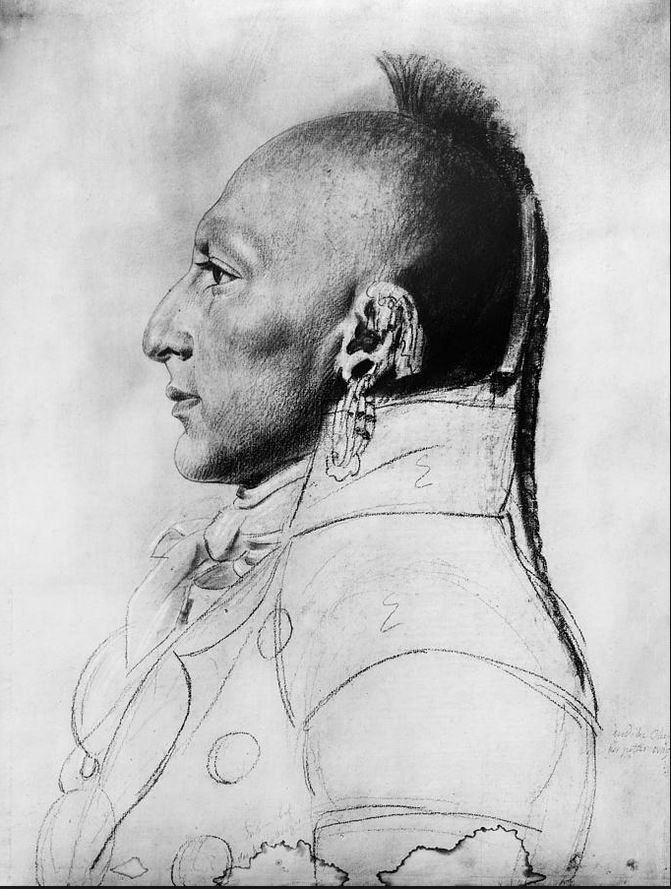
Miller, George M - wax portrait of a man

Rarer than ivory miniature portraits, are wax portraits such as this one.

It has been attributed to George M Miller (?->1821?). SIRIS list five wax portraits by him and suggests he died in 1819, but another reference (Bolton) states he exhibited a wax portrait of Talbot Hamilton in 1821.

In her work on wax sculptors, Bolton attributes 23 wax miniatures to Miller, but at least one of them is wrong, as it is signed by the German was sculptor Curiger.

Miller originally emigrated to the United States from Germany under the name Mueller. He was a potter, stone-cutter, and modeller and worked in Baltimore, New York, and Philadelphia, being active from 1790 to 1821.

He was a member of the Pennsylvania Academy of Fine Arts where he exhibited several waxes between 1813 and 1821, including one of James Madison (whereabouts unknown). He was also a fellow of the Columbian Society of Arts.

There were a few other modellers in wax. The most famous was Patience Wright, but others of note included Johann Christian Rauschner (aka John Christopher Rauschner), Valaperta, and Robert Ball Hughes.

The work of Miller and Rauschner is similar, but Miller's sculptures tend to be a little smaller. For example with this one, the actual wax is 40mm x 20mm.

Rauschner apparently used colored wax throughout, whereas with this Miller wax, the face is colored, but the coat is white wax covered with brown pigment. The sitter has a pigtail, although it is hard to see in the image here.

The waxes were made by pressing soft wax into a mould and hence multiple copies could be made. The resultant model was then mounted on black glass and framed, often with a distinctive style of metal frame imported from Germany.

Although there is some similarity with this miniature of James Madison, which is by Charles Willson Peale, it seems unlikely this is a version of the Madison portrait as Bolton records that as right facing.

There are three other American wax miniatures in this collection.

Until now they have all been attributed to Rauschner, but they need to be revisited to determine if any should instead be re-attributed to George Miller.1326

Sunday

Unknown - portrait of Judge John Speed

Fortunately acquired for the collection is this miniature portrait painted on ivory in 1840 by an unknown artist for Lucy Gilmer Speed. It is of Judge John Speed (May 17 1772-Mar 30 1840), the father of Joshua Fry Speed (Nov 14 1814-May 29 1882), the great friend of Abraham Lincoln.

On April 15, 1837, Lincoln arrived at Springfield, the new state capital, in order to seek his fortune as a young lawyer. Lincoln needed to set up housekeeping and went to Speed's store to buy a bed. Lincoln asked to buy the bed on credit but young Joshua Fry Speed offered to share his own large upstairs room, resulting in the two settling in as room-mates. This in turn led to the development of a life-long friendship.

Judge John Speed was also the builder and original owner of the historic home Farmington, which he built in 1815/1816 for his wife, Lucy Gilmer Fry, daughter of Joshua Fry and granddaughter of Dr. Thomas Walker, the guardian of Thomas Jefferson.

Lucy knew Monticello, the home of Thomas Jefferson and there are design similarities between Farmington and Monticello, the latter as shown here being completed in 1809.

For example, they both have octagonal rooms, a distinctive feature of Jeffersonian architecture. Lucy's aunt and uncle's home in Charlottesville, Virginia was also called Farmington and had an addition designed by Thomas Jefferson.

Judge John Speed was descended from the British cartographer of the 17C, see A genealogy of the Speed family since the 16th century

Judge John Speed was also the father of James Speed (Mar 11 1812–Jun 25 1887), who was appointed to the cabinet of Abraham Lincoln as Attorney General in 1864. See James Speed - Wikipedia, the free encyclopedia

One of the Judge's daughters was Susan Fry Speed (30 Sep 1817-Nov 1888). She is referred to below in connection with some other Speed and Lincoln memorabilia acquired with this miniature.

The miniature is 43mm x 35mm in size and the reverse of the unusual octagonal shaped case is inscribed "L G Speed" for Lucy Gilmer Speed, who was the second wife of Judge John Speed.

The birth of John Speed was recorded at Charlotte Court House, Charlotte, Virginia. He was the son of James Speed and Mary Spencer.

He firstly married Abigail LeMaster (aka Abby LeMaster) on 1 Nov 1796 (sometimes 26 Nov 1796) in Jefferson, KY. Abigail (c1775-Jul 1807) was the daughter of John LeMaster and Jemimia Floyd.

There are reports of up to four children, James Speed (1797-1797), possibly a second James Speed (1799-1799), Mary Speed (1802-?), and Eliza Jane Speed (1805-2 Jul 1885). Eliza is buried at Cave Hill Cemetery, Louisville KY.

As a widower with two small children, John Speed then secondly married Lucy Gilmer Fry on 15 Nov 1808 at Mercer, KY. Lucy Fry (23 Mar 1788-27 Jan 1874) was the daughter of Joshua Fry and Peachy Walker.

Judge John Speed was then 36 years old and thus 16 years older than Lucy. Family history sites suggest they had eleven children with most of them born prior to 1819. The eldest, Thomas Speed being born on 15 Sep 1809.

John Speed served in the United States forces in 1791 against the Indians and the "Farmington" property in Judge John Speed's life was reportedly the scene of lavish hospitality extended not only to kinsmen and friends, but even to an army, for it is said, that the volunteers for the War of 1812, passing "Farmington," were entertained in entire companies and even larger bodies of men. Although this was before the main house was built in 1815.

At around this time, in 1820, Louisville’s population was 4,180 of which 1,031 were slaves and 95 free people of color.

Speed commenced construction of a homestead in 1815, which was completed in 1816. It is shown here together with four outbuildings in John Rutherford's 1820 gouache, which was painted some 65 years before the first known photo of the house.

It is now the historic home Farmington Historic Homes Foundation - Farmington According to tax lists, John Speed owned 12 enslaved African Americans in 1811, 39 in 1812 and 43 in 1813. By 1820, John Speed is listed as owning 55 slaves. This rapid increase in slave ownership reflects the establishment and development of Speed's plantation at Farmington.

The main cash crop was hemp, which was used to make rope and bagging for the cotton trade. The farm also produced corn, hay, apples, pork, vegetables, wheat, tobacco and dairy products. The tasks of planting, harvesting and shipping products to market were performed primarily by enslaved African Americans who worked in the fields, labored at the ropewalk and drove the wagons.

Farmington has a place in history, as shortly after the 1840 death of Judge John Speed, in 1841, Farmington hosted its most famous guest, Abraham Lincoln.

Tired and despondent over breaking off his engagement to Mary Todd of Lexington, and also worried about the direction his political career was taking, Lincoln came to Farmington to visit with Joshua Speed and his family. He stayed about three weeks with the Speed family during August and September 1841. The courtship of his friend Joshua and Fanny Henning gave him some hope about his own future. After rest and relaxation, Lincoln returned to Springfield and to renew his wooing of Mary Todd. Their subsequent marriage is history.

At least six of Judge John Speed’s sons and grandsons served in the Union Army during the Civil War.

The Speed Art Museum has in its collection two similar images of Judge John Speed as shown here. One is a large oil by Matthew Harris Jouett (1788-1827).

The second is a miniature watercolor said by the Speed to be on paper, although it looks as if it may be on ivory. It is 51mm x 41mm and is by an unknown artist.

All three portraits appear to be based on the same pose, looking at the viewer and with his spectacles pushed back on his forehead.

Most likely, the Jouett portrait is the original, obviously painted before Jouett died in 1827. In that year Judge John Speed would have been aged 55 and, although the image is difficult to see, Speed looks a little younger than 55, which suggests the oil portrait was painted around 1820.

Differences between the two miniatures are subtle, as can be seen by comparing them, but sufficient to be confident they are not by the same artist.

The artist for this octagonal miniature is unknown, but there is part of a trade card used as packing in the reverse, with the wording "..den Lane New York". A kind visitor has suggested this refers to Maiden Lane, in Manhattan, with the trade card referring to the artist or jeweller who made the case. This suggests the miniature was painted and/or framed in New York. However, there were some 120 miniature painters in New York at this time and hence it has not been possible to identify the artist.

From the style of the case it probably dates to the early 1840's. Judge John Speed died in 1840 and the most likely explanation is that Lucy Gilmer Speed commissioned the miniature in 1840, so that she could wear it in memory of him.


Within the Speed Museum collection there are these three portraits of Lucy Gilmer Speed but, unfortunately, she does not appear to be wearing the miniature in the paintings.

The one on the left is a miniature in a case which is difficult to date. The middle portrait in color is an oil by Jouett who, as noted above, died in 1827 and probably painted the oil of Judge John Speed around 1820.

That suggests the oil of Lucy Gilmer Speed by Jouett which is of identical size, was also painted around 1820, when she was aged 32.

However, she looks to be quite some years older than 32 in the oil portrait, which raises the possibility that the portrait does not depict Lucy Gilmer Fry but some other family member, unless the years, her own eleven children, and her two step daughters had caused time to be particularly unkind to her!

The various other portraits of the Speed family above are in the Speed art Museum collection and full details about them can be viewed via the Kentucky Online Arts Resource (KOAR) Home

When the miniature of Judge John Speed was acquired, it was accompanied by several other items of memorabilia associated with the Speed family and Abraham Lincoln. These items are associated with descendants of Judge John Speed's daughter Susan Fry Speed (30 Sep 1817-Nov 1888) who married Benjamin O Davis (3 Jun 1806-15 Mar 1861) on 5 Jun 1838.

One of the children of Benjamin and Susan Davis, was Lucy Gilmer Davis (30 Aug 1840-3 Feb 1924) who married J Edward Hardy (5 Nov 1834-?) on 18 Jun 1861.

One of the children of J Edward and Lucy Hardy was Frank Whittle Hardy (aka Frank Hardy) (see references to F W Hardy below) and a daughter was Charlotte Howard Hardy.

Charlotte Howard Hardy (aka Lottie Hardy) (1862->1930) married Charles Pettet Robinson (1854->1930) and their daughter was Lucy Gilmer Robinson (Jan 1896-May 1987) who married ? McCormick (?-<1930) in 1921. She is also known as Gilmer Robinson McCormick as referred to below. It appears her husband died before 1930, as in the 1930 census, she was living as a widow, with her 8 year old son, John N McCormick at her parents' home.

There is an actress and singer named Gilmer McCormick who was born in Louisville in 1947 and seems likely to be the granddaughter of Lucy Gilmer Robinson McCormick, see Gilmer McCormick - Wikipedia, the free encyclopedia She is best known for for her performance in the stage and film versions of Godspell in the early 1970s and for her role in the 1984 horror film Silent Night, Deadly Night.

One of the items acquired with the miniature portrait of Judge John Speed, is a very old photograph of an oil portrait of a Speed family member. He is believed to be the son of Judge John Speed, but the whereabouts of the original oil portrait is unknown.

On the reverse there are several partially illegible inscriptions, but the following can be read; "Mrs Edward Hardy Ky St" and "J E Hardy 117 W Ky" and "8 cream on board".

These appear to relate to instructions for creating copies of this photograph of the oil portrait.

However, the oil can be compared with this miniature portrait of Joshua Fry Speed which is owned by the Filson Historical Society, Louisville, KY.

Although an image of the young James Speed has not yet been located, a photograph of him in later life is shown here.

Of the two brothers, Joshua Fry Speed seems the most likely to be the sitter in the oil, but the help of any visitor able to confirm the sitter's identity would be appreciated.

Three other items came with the miniature of Judge John Speed, two books and an engraving.


One book seems to be quite common. It is a 1908 edition of "A Perfect Life" by Mary Raymond Shipman Andrews, and which contains an engraved portrait of Lincoln.

The flyleaf of the book is inscribed; "F W Hardy 117 W Ky St, Louisville, Ky", the same family as mentioned on the reverse of the image of the oil portrait above.

The second engraving is a profile portrait of Lincoln which seems to have been cut down from another source. It has a facsimile image of Lincoln's signature.

It appears to be signed "Mandel(?) Murphy UWI(?)". However, it is possible that the word Mandel may be Cryllic for Murphy, as the "N" is back to front and the "E" is a "C".

Thus any thoughts on the origin of this profile engraving would be welcome.

The last item is another book by Joshua Fry Speed which seems to be uncommon, as there are few Internet references to it and no original copies appear to be available for purchase.

The exterior cover is titled "Lincoln - California - by Joshua F Speed".

Inscribed on the flyleaf is "Mrs Wm Robinson from her friend Fanny Speed" and underneath that is "Gilmer Robinson McCormick".

From the information above it is can be seen that Gilmer Robinson McCormick was a great-great-granddaughter of Judge John Speed.

The full title of the book is "Reminiscences of Abraham Lincoln and Notes of a Visit to California - Two Lectures by Joshua F Speed".

It has 67 pages and was published by John P Morton and Company in Louisville, KY in 1884.

Joshua Fry Speed married Frances Henning (aka Fanny Henning (1820-1902) on 12 Feb 1842. They had a marriage of 40 years, but they had no children.

Joshua Speed died in 1882 and so it is probable his wife Fanny Henning Speed arranged the printing of the book in 1884 after his death.

Joshua and Fanny are shown in this double portrait, with Joshua's arm around Fanny.

In the 1850 census, Fanny's mother Elizabeth Henning (1785-?) was living with them and they disclosed assets of $20,200.

They can be tracked through subsequent census records, although Fanny could not be found in the 1900 census.

They are interred together at Cave Hill Cemetery which is a 296-acre Victorian era National Cemetery and arboretum located at 701 Baxter Avenue, Louisville, Kentucky. 1327

Thursday

Wagner, Daniel and Maria Louisa - portrait of a lady

There are a number of American miniature painters who are deservedly well known for the quality of their painting.

There are others, sometimes demonstrating even more skill than those well known names, whose names are completely unknown, or whose name is known, but their work is very rare.

In my opinion, this stunning miniature portrait comes into the latter category.

The photos displayed here, while illustrating the skill of the artist, do not convey the depth of colors and the vibrancy of the miniature when viewed in the hand or under a magnifying glass. It is 95mm x 77mm and contained within a leather case.

The portrait has moved straight to the top echelon of my personal favourites among the American miniatures in this collection.

I feel the actual painting skill is similar to that displayed by John Henry Brown. However Brown was trying to emulate photographs and his miniatures tend to be flat, whereas this miniature was painted just before the introduction of photography and has a depth that very few other miniature painters have equalled.

Unfortunately, the name of the sitter is unknown, although the previous owner has believed it had probably been in a drawer in the same house in Raymond, Maine since before 1880.

If any of the occupants of the house at that date had been known, it may have been possible to back track through census records to determine the likely sitter.

The skill of the artists can be seen in the close ups of the head, her wrap, and her hands. It is almost possible to read the writing on the letter she is holding.

The miniature is clearly signed on the reverse "D and M L Wagner December 1839". Above the signature there is an earlier erased signature which is indecipherable. It appears to start "By Daniel ......." but there are two interpretations.

Firstly, that it read "By Daniel Wagner" but then it was amended to include his sister's name.

Secondly, that it may have read "By Daniel and Maria Louise Wagner" but the wording was then found to be too long to fit on the reverse of the miniature when the paper was cut down to size and so the signature was rewritten to fit the piece of backing paper.

Not much is known about the lives of Daniel (14 Apr 1802- 21 Jan 1888) and his sister Maria Louisa Wagner (1815-20 Oct 1888). He was born in Leyden, MA and worked in Utica NY, Albany NY, NYC and died in Norwich NY.

To date they have only been found in the 1880 census record which shows Maria Louisa as born in NY state and elsewhere she is recorded more precisely as born at Preston, Chenango, NY in 1815. She worked in Chenango Valley, NY, Albany NY, NYC and died in Norwich NY in the same year as her brother. Maria Louisa is buried at Mt Hope Cemetery,Norwich, NY.

In the 1880 census, they are recorded as living in Rochester NY, Maria as 62 years old and with no occupation, but Daniel describing himself as 78 and as "portrait and landscape painter". They record both their parents as born in Massachusetts. Daniel is not referred to as crippled, despite the reference below to him being crippled.

Their father was Frederick Wagner (1777-16 Jul 1868) who had been born in Worcester, MA, possibly the John Frederick Rudolf Wagner born on 19 May 1778 in Worcester, whose parents were Caterina Elizabetha Wagner and Johan Jacob Wagner.

Frederick Wagner married Anna or Hannah Walworth (21 May 1778-6 Sep 1847) who had been born in Leyden, Franklin, MA. They were married on 03 Jan 1799 at Leyden, Franklin, MA and had 13 children, of which Daniel was the eldest of four sons, and Maria Louisa was the seventh of nine daughters.

The reverse of the ivory shows how some artists added depth to their work.

Among American miniature painters there are very few examples of miniatures being jointly signed. Other examples include; "Inman and Cummings" and "Doyle and Williams". However, the Wagner's seem to be unique as signing as brother and sister.

According to Women's Culture: American Philanthropy and Art, 1830-1930 - Google Books Result Maria took up miniature painting to help care for her crippled brother.

Other works by them seem to be rare. The only one I can find is a reference to this portrait of Henry Rowe Schoolcraft by Maria Louisa Wagner, which is inscribed on the reverse "Painted by/Mary Louis Wagner/Washington ["Albany" is crossed out] /June 1852/The Property of Ester Schoolcraft." This seems to suggest that they also worked as individuals.

The year 1839 that this fine miniature of a lady by Daniel and Maria Louisa Wagner was signed, is poignant in the history of miniature portraits, as it is the year before the introduction of daguerreotypes began to hit miniature painters like a tsunami.

Thus 1839 could be said to represent the high tide mark for American miniature painting. This miniature certainly deserves to be regarded as a worthy example to mark that high tide. 1322

Wednesday

Gimbrede, Thomas - portraits of man and lady


Recently, the opportunity arose to purchase this nice pair of American miniatures.

They are probably husband and wife, but unfortunately no history came with them, so it is not possible to determine whether they are marriage portraits.

They are both unsigned and trying to determine the artist has been frustrating, although at present they are attributed to Thomas Gimbrede on the advice of a very kind visitor who is more knowledgeable about miniatures than I am.

Two examples by Gimbrede are shown here, but his miniatures are relatively uncommon. The black and white one is a self-portrait painted c1806 and belonging to the Metropolitan Museum . The one in color was sold by Bonhams in 2007.

Gimbrede was born in Agen, France in 1781 but emigrated to America, where he worked in New York and Baltimore as an engraver and miniature painter, before taking up a position as teacher of drawing and of French at the West Point Military Academy, where he died 24 Dec 1832.

Judging by the comments on his grave at West Point, where it is recorded he was drawing master for 14 years, Gimbrede took up his position in 1819, see The History Box| Learning About New York State Part IX That does not mean he ceased painting miniatures after 1818, but presumably his output of miniatures was reduced.

Gimbrede was remembered by many West Point students for his comment at the start of each course; "There are only two lines in drawing, the straight line and the curve line. Everyone can draw a straight line and everyone can draw a curve line, therefore, everyone can draw."

Whilst drawing may today seem an unlikely skill for military cadets, in the 19C it was a vital skill, especially in the years before photography, so that details of terrain and enemy fortifications could be sketched and conveyed back to headquarters.

Gimbrede was also an early experimenter at wine growing in the United States. At A History of Wine in America "d0e5342" there is the quote:

"A few miles north of Croton Point, a Frenchman named Thomas Gimbrede was experimenting with native vines at West Point, where he taught drawing to the cadets. Starting about 1820, Gimbrede had collected every variety that he found growing wild in the woods and transplanted them to his garden, "manuring, stimulating and pruning them with great care, in the hope of changing and ameliorating their character." After fifteen years of such experiment, Gimbrede was candid enough to admit that he had had no luck whatever: the natives remained obstinately unimproved by their pampering. But perhaps this barren result may have helped put an end to the notion, so long and fondly entertained, that the "wild" grape could be "tamed" by so simple a process of cultivation in which, as one writer has said, the experimenter acts as a sociologist instead of a geneticist."

Nevertheless, to my untrained eye, I worry there are some differences of style, so I must confess I am still wondering if the miniatures might be by a different artist. (However, for later discussion by my kind visitor in response to my thoughts below, please see the helpful extra comment at the bottom of this description, which also helps illustrate that attribution is an inexact science!)

The two other examples shown by Gimbrede appear to have the opaque gouache background usually associated with artists trained in France and they have a more finely delineated style, that is often seen with artists trained as engravers. Gimbrede was also an engraver and some examples of his engravings are shown below.

In contrast this new pair, has the wash type sky backgrounds of artists trained in the British method of painting miniatures and more of the ivory is allowed to show through in the flesh areas. They are a little better painted than these scanned images show.

There is fine detail in the hair and clothing, but in the delicate manner of a very good painter, rather than an engraver. The colors are a little brighter than the images show, with the coral earrings and necklace being the very same shade of orange used by Richard Verbryck when he painted jewellery.

Based upon the hairstyles, they seem to date from around 1825-1830. Interestingly, both have the same rear case work, copper with an oval aperture, although the rear glass and bezel are missing from the man.

However, the fronts of the cases are different, the man being of the plain style in gold used from 1800 to 1825 and the lady being the chased foliate style with a beaded bezel used from 1825 to 1840. Her front beaded bezel is too distorted and tightly wedged to open, thus it is not possible to clean the interior of the glass.

It therefore appears the cases were made at a transitional time of changing fashion in case work, perhaps with the lady having the then latest fashion of chased foliate work for the front, at the time when the rear of the cases continued in the previous fashion.

There is no interior packing for either portrait, which is unusual, and as the lady's bezel appears never to have been opened, the ivories were presumably originally framed with out any backing paper.

When considering some other possible artists who were skilled and also active around 1825, the following have been eliminated; Eliza and Sarah Goodridge, Nathaniel Rogers, William Doyle, Henry Williams, Anna Peale, and several others. Certainly, the artist is more skilled than average.

Comparatively speaking, the best match I could come up with for the pose, and style of painting the man's clothing, was fig 47 in Dearborn. This is the portrait shown here of T T Heartie by Anson Dickinson, which has the same fine parallel frilled folds on his shirt. However, I accept that Anson Dickinson is probably not the artist.


Thus, if any other visitor has views on the artist, whether confirming Gimbrede or otherwise, I would be grateful to hear from them.

As further examples of Gimbrede which may be of interest, here are several portraits which were engraved by him. 1323, 1324

Extra visitor comment.
I want to correct a couple of incorrect assumptions that you have made. A grey solid wash background, not necessarily gouache, is typical of artists who worked or trained on the continent. Outside of Jos Saunders, I can't recall ever seeing an English artist use this type of background. In any case, a close inspection a an English artist using a relatively solid background, usually brown or greenish, would show that it is almost never a float but a series of brushstrokes, either stipples or cross-hatching. Floating a solid background is typically continental, hence, I doubt that your pair are done by an English trained artist. And saying that because it is delicately painted it could not be done by an engraver just doesn't hold water. Check out the miniatures of Nathaniel Jocelyn for example. Extremely fine detail on his later pieces and his earlier pieces show great delicacy. There are lots of other examples too. Many engravers were first very good painters. As for the cases...there is a definite overlap in time for these cases. The plain cases were used up to around 1820 and the chased cases actually came in just before 1820. This is not to say that these are by Gimbrede, (although I feel that they probably are) but there are very few artists working in this style at this time. Often there is just a feel about a piece that can be difficult to put into words. On the other hand I have a list of over 130 artists working at about the time these were painted, many of them foreign trained, and I have only seen the work of about 1/3 of them. So who knows what may come to light in the future.

Unknown - portraits of lady and gentleman


Miniature portraits come in various sizes, largely depending upon the fashion of the time and the wealth of the person who commissioned the portrait.

In the 18C, up to around 1790, they were mainly oval and small in size, say 45mm x 35mm. This is sometimes referred to as "modest school" from the size.

After 1790, the standard size for oval miniatures tended to be around 70mm x 76mm and the lasted until it overlapped with rectangular miniatures around 1810 onwards.

Rectangular ones tended to be 80mm x 60mm or larger.

This pair are very unusual for the post 1800 period in being modest size at 40mm x 30mm.

There are only two other American miniatures in this collection which are post 1800 and of modest size. They are all shown here compared with a miniature of more normal size.

Attribution of the pair of miniatures has not been possible so far. From the style of painting, for example the pose, the eyes, and the mouths, it is clear that they are both painted by the same artist. From the clothing and hair styles, they look to be from around 1820, probably American given the frame style.

However, a kind visitor feels they look Continental. A likely explanation is that they were painted in America by an artist originally trained in France.

After the French Revolution and the Napoleonic Wars, a number of miniature painters emigrated to the United States.

The images are sharper than appears here, as they have been scanned through the glass.

As can be seen from the images of the reverse of the four modest school miniatures, the rear of the cases are all plain gold.

Thus, they are all opened via the front. this often being the sign of an American miniature.

The pair has plain bezels, whereas the two small unmatched miniatures have beaded bezels, normally a slightly later decoration after around 1810, but also normally a sign of an American miniature.

Regretfully, the sitters are unknown. 1321a, 1321b, 880, 909

Monday

Unknown - portrait of mother and baby

Unfortunately this miniature portrait is unsigned and the sitters are not known. However it is American and dates from around 1840.

The artist is uncertain at this point, but it should be possible to come up with an attribution at some stage from a comparison of styles.

American and indeed miniatures from all countries, with more than one sitter are very much in the minority, but it is interesting to compare this portrait with a random selection of some of the "mother and child" portraits from history. This shows what a timeless image it is.


Dickinson, Anson - portrait of a gentleman

This miniature portrait is by one of the better known American artists, Anson Dickinson (1779-1852) who worked in Connecticut.

The sitter is unknown, but from a comparison with examples of his work in various books, including those in the 1983 biography of Anson Dickinson by Mona Leithiser Dearborn, it would appear to date from around 1835/1840 when the collar worn by the sitter was common.

Dickinson painted no fewer than 1500 miniatures during his lifetime, but as there is no inscription it is impossible to determine the sitter.

The outer frame was missing when purchased and the name of the sitter may have been removed by the family member who sold the miniature, as on a piece of old wooden backing that came with the miniature there is a small piece of torn paper that reads only "Mr".

As I have said previously, I feel it is very sad when sitters lose their identities. They can only lose them once.

Unfortunately, Dickinson used a fugitive blue in the background, so that where the portrait has been exposed to strong light, the blue has been bleached out, leaving only the reddish tones.

In Dearborn's biography a similar effect can be seen with two miniatures of ladies figs 93 and 94.

Nevertheless the skill of the artist is apparent. It is possible to have such color loss retouched, but that requires the expertise of a professional restorer.

A simpler option is to use a mask that hides the darker section, as has been done here.

There is another miniature by Anson Dickinson in this collection where there is no bleaching and this example shows what the original coloring would have looked like, see View

Despite the bleaching, it is a good portrait showing Dickinson's technique and one that can always be restored at some time in the future. 1308

Dyart, J - portrait of girl with a blue ribbon


Acquired recently is this attractive miniature portrait which is American judging by the front opening case, fancy bezel, and the shape of the hanger.

The case seems to be made from unmarked sterling silver.

There is a apparent signature on the lower right in very small and indistinct writing.

The best estimate of this signature is perhaps "J Dyart", but no artist of that, or any similar name has been found. However, the artist although unconfirmed, was very competent as there is no sign of a photographic base.

Judging by the ringlets of the unknown sitter, the miniature probably dates from 1900 to 1910.

It came from Chester, New York and so that may provide a further clue to the artist at some time in the future. 1303

Belzons (?) - portrait of a gentleman


Unfortunately this miniature portrait is unsigned and unidentified. However, it is definitely American in style with a fine early 19C case, where there are beaded bezels both front and reverse.

Inside, the packing includes part of a trade card which reads;
"constant supply, of the best quality, .nd of Segars and, .d perfume, which, of weak nerves, .id will be duly, Oct 25, 1804."

Correspondence with Tony Hyman, the owner of the National Cigar Museum has established that this is part of a trade card previously unknown to him and thus a rare trade card.

During our correspondence, I was able to send him copies of a number of early cigar advertisements taken from copies of J Russell's Gazettee dating from as early as 1800, which are held as part of this collection as they support a miniature of the newspaper publisher, John Russell himself, see View which was painted by Henry Williams.

The miniature was acquired at a rural auction in Georgia, only about 90 miles from Charleston. Thus initially, there was a thought that it might be an early work by Charles Fraser. Fraser's later work tends to be more stippled, but his earlier work was influenced by Edward Greene Malbone.

Backgrounds as dark as this are more associated with artists trained in France, but the pose is similar to miniatures painted by Fraser in 1803 and 1804 as shown in the Carolina Art Association catalogue. For example see the portrait of James Reid Pringle.

The early date was supported on opening it and finding the 1804 trade card, which while not being firm evidence of an 1804 origin, does fit with the date of the costume worn by the sitter which is commensurate with a date of 1804-1810.

Initially, a kind visitor expressed the opinion that the miniature may be by John Marras who was born in France, but worked in New York between 1801 and 1808, before moving to Constantinople where he became painter to the Sultan.

In 1994 Christie's sold as Lot 146; "JOHN MARRAS, Dated 1804 portrait miniature of Mrs. McAwly Watercolor on ivory, signed l.l. John Marras fecit 1804, the case inscribed, "Mrs. McAwly, Temora," 3 1/8 in. high. John Marras was a French portrait miniaturist working in New York City during the first decade of the 19th century. He later appeared as a court painter to the Sultan in Constantinople." Unfortunately no photograph is available.

Little is known about John Marras. In his book William Dunlap refers to a M. (presumably for Monsieur) Maras, but is not complimentary, saying "A Frenchman by birth, M Maras visited America about the year 1800. In 1801-2 he painted poor miniatures in New York. A poor or bad artist flourishes best where the people are most ignorant; and M. Maras, with great judgement, transferred himself to Constantinople, where he is at the head of affairs in the department of the fine arts, and painter to the sublime Sultan."

Although it is known that Dunlap could be very uncharitable with his comments, there must be doubt that he was referring to the skilled artist who painted this miniature. Additionally from the sale example above, Marras seems to have signed his work. The skill demonstrated in the miniature seems broadly comparable with the work of Malbone and Fraser from around 1805.

There were few artists with this degree of skill working in America at this time and the Charleston connection has raised another possibility for the artist.

Recently, I came across a reference with respect to Charles Fraser in Huger Smith commenting; "We are told that a French painter, named Belzons, was his first master, but from lack of knowledge of Belzon's own work we cannot estimate his influence on his pupil's style, but of Malbone's influence there can be no doubt."


Appearing facing page 20 of Huger Smith and shown here for comparison, is Fraser's 1827 portrait of Charles Winthrop (1800-1833).

The pose, the manner of painting the hair, and the general appearance of the two miniatures are similar. This suggests Fraser was influenced by, if not trained, by the painter of this miniature.

Adding the 1804 date of the trade card and the acquisition of the miniature from a country auction only 90 miles from Charleston, seems to make an attribution to Belzons a reasonable proposition.

Belzons (sometimes Jean Zolbius, for example it was the name he used when he married) was a respectable artist and a leading scene painter of the Charleston theater. He advertised as having been a student of the famous French painter, David. Belzons worked in Savannah, Camden, Georgetown, as well as Charleston. In 1795 he "established his price at five pounds for a likeness and will furnish plain gold elegant setting for the additional price of two pounds."

He also acted, but his profession was miniature painter and as a drawing master he operated a school from 1800-1812. Apart from teaching Charles Fraser, Belzons was also first master to Thomas Sully.

In fact, Belzons was a brother-in-law to Thomas Sully, as Jane Sully married Belzons on 25 Nov 1794. Thomas did not like his brother-in-law Belzons, who is thought to have died in Savannah about 1816.

Thus, this miniature may be by Belzons, due to the similarities with some early work by Fraser. However, until we see some signed pieces by Belzons, a firm attribution to him will have to wait. 1300

Micailo - portrait of a baby


The origin of this miniature portrait is uncertain.

It appears to be signed "Micailo" which may be Italian, but the frame does not appear to be Italian.

Micailo appears to be a form of Michael or Michaela, and may even be the name of the sitter.

The frame is too tight to be able to open it without risk of damage to the glass or painting.

It may even be British, but has been included here as the style has some similarities with American miniatures of babies.

No record has been found of an artist with the same or a similar name.

The sitter is unknown. 1299

Saturday

Hall, E A - portraits of Root Family from Uxbridge


These three miniatures were offered at auction as three separate lots. Thus there was a risk that the three related sitters from one family would be separated forever.

It was fortunate that the hammer prices were not too high and so it was possible to acquire all three miniatures for the collection.

They represent an excellent example of how a forgotten family can be "brought back to life" just from their bare names, to such an extent one can see how they fitted into the social fabric of their times.

Visitors to this site may like to read a little essay about the portraits titled "A Forgotten Family Story" at View before proceeding to read the description below.

The miniatures are all signed on the right "E A Hall" as shown in the two examples, and the cases all engraved on the rear with the initials and name of the sitter; the man "Charles Arthur Root - Dec 25, 1925", the older lady "Jane Wheelock Root - Dec 25, 1925" and the younger lady "Deberah (sic - one wonders why a replacement with the correct spelling, Deborah, was not requested) Root - Dec 25, 1927". Thus it appears they were painted as Christmas presents.

To date a closer identification of the artist has not been possible, although it is possible he/she is related to E A Hall & Co of Greenfield, MA. Conversely, clear identification of the sitters and some detective work has made it possible to learn much about the family.

Charles Arthur Root (11 Sep 1874-1932) married Jane Frances Wheelock (24 Sep 1872-1954) around 1898 and various Internet references strongly link the family to Uxbridge, MA. Charles and Jane had three children, Dorothy, Deborah (shown here), and Charles Jr.

As these three miniatures are all dated December 25, it seems fairly certain that elsewhere in the world, there are miniatures of the other two children, Dorothy Root and Charles Root Jr, also dated December 25.

Charles Arthur Root Sr was the son of Charles B J Root (1846-?) and the grandson of Hezekiah Root (6 Feb 1803-?) and his second wife Maria Jenks who were married 15 Dec 1831. Hezekiah and his family were all involved in the grocery and dry goods business, although in 1850 Hezekiah had been a farmer.

The Roote family can trace their name back to before their earliest arrival in America, Thomas Roote who was born in Northampton England in 1605 and was married in Hartford CT in 1638. Much information being contained within "The Root Family" by J P Root, published in 1870.

Jane Frances Wheelock Root is referred to in the 1880 census as Jennie F Wheelock and also in the 1969 book by Walter W Wheelock "The Wheelock Family in America, 1637-1969", where she is referred to as Jennie Frances Wheelock". She had the DAR ID Number: 23432 Her DAR lineage was;
Descendant of Lieut. Simeon Wheelock and of Capt. Edward Seagrave.
Being daughter of Charles Edwin Wheelock (1842-1915) and Jane Frances Sprague (1847-1915), his wife.
Granddaughter of Charles Augustus Wheelock (1812-1895) and Nancy Seagrave (1815-1911), his wife.
Gr.-granddaughter of Jerry Wheelock (1784-1861) and Sukey Day, his wife; Bezaleel Seagrave and Lucy Taft, his wife.
Gr.-gr.-granddaughter of Simeon Wheelock (1741-1747) and Deborah Thayer, his wife; John Seagrave and Sarah Dorrington, his wife.
Gr.-gr.-gr.-granddaughter of Edward Seagrave and Lois White, his wife.
Edward Seagrave, (1722-93), commanded a company of militia, 1775-78. As he was the oldest captain in the regiment and unable to undergo further military service he resigned his commission, 1779. He was born in England; died in Uxbridge, Mass.

The main significance of the Root family was as the owner of woollen mills, including Uxbridge Worsted Co, in partnership with Louis Bachman. It was in 1907 that Louis Bachmann of New York City and Uxbridge's Charles Arthur Root organized a small woolen and worsted plant on the site of the Old Scott's Mill. Later they bought the Capron Mill whuch had made textiles for military uniforms during the Civil War and did so for subsequent conflicts.

Half a century later, the Uxbridge Worsted Co. boasted 13 plants in four states, with 6,000 workers producing enough fabric annually for six million garments. The group having also bought the Rivulet, and Davis and Brown Mills.

The Root family did have a philanthropic side; one reference to the family is for the Unitarian Church at Uxbridge, where it is noted "The Hook-Hastings electric organ was installed in 1926, given by Mr. and Mrs. Charles A. Root in memory of her father, the Hon. Charles A. Wheelock", see Church History - Unitarian Congregation of Mendon &; Uxbridge ...

Another reference is to the Coronet John Farnum House on Mendon Street near the Mumford River falls. Farnum and his wife, Mary Tyler of Mendon, built the house there in 1715, before Uxbridge became its own town. It remained a private residence until 1926, when the house was purchased and restored by the owners of the Uxbridge Worsted Co mill across the street. Today, the town-owned building serves as headquarters for the private Uxbridge Historical Society, see Town Hall holds the ghosts - Milford, MA - The Milford Daily News

In 1920 Charles Root also part owned the Uxbridge Inn in Uxbridge, originally built as the Hotel Windsor. The wide veranda on the front was a reviewing stand for parades and ceremonial events. Through the years, it was a popular spot for travellers whether arriving by horse-drawn coach, train, or automobile. The woollen mills attracted many European visitors to the inn.

In 1924 Uxbridge Worsted Co helped to establish the Blackstone Valley Industrial League which enabled baseball competition between the various mills. This is regarded by some historians as part of a very paternalistic management style, see baseballBVLeague In 1928 Charles A Root was a Republican Delegate from Massachusetts to the Republican National Convention.

Charles Root seems to have been a hard businessman, particularly during the Great Depression when unemployment in larger Rhode Island mill communities such as Pawtucket and Woonsocket ran as high as fifty percent. Figures for Blackstone Valley towns in both Massachusetts and Rhode Island were much lower but misleading because once unemployed, a worker and his family were evicted from company housing and, quite literally, the community as well.

In January 1932 workers launched a bitter strike at five mills belonging to the Uxbridge Worsted Company, protesting a reduction in wages. The workers lost their strike when owner Charles Root threatened to close the mills permanently. Perhaps due to the stress of this strike and the Great Depression Charles Root Sr died in 1932, aged 67. In 1934 workers at Rockdale, Uxbridge Worsted Company and other Blackstone Valley mills joined a national strike by textile workers from Maine to Georgia for recognition of the Textile Workers Union.

Rockdale employees eventually returned to work, but only after the company sold workers' homes to break the union. Similar threats were made by employers elsewhere in a coldly calculated strategy designed to deliver an irrevocable message to workers who might consider further protest. For workers this strike and its results became the symbol of paternalism's end in the Blackstone Valley. Employers throughout the region pointed to it as an example of the evils of unionism and their reaction successfully forestalled union organization for another fifteen years in most Massachusetts Blackstone mills.

After Mr Root's death in 1932 the name changed to Bachman-Uxbridge Worsted Corporation and operated as such until it was sold to Emile Bernat & Sons, Inc in 1962.

Census information provides more information about the family. In 1910 Charles and Jane Root lived with their three children, Dorothy 10, Deborah 6, and Charles Jr 3 in Uxbridge close to Jane's parents Charles and Jane Wheelock and their family. In the 1930 census, the Root family still lived in Uxbridge; Arthur C Root aged 55, Jane W Root aged 57, Deborah Root aged 26 and Charles A Root Jr aged 23. They had three servants and disclosed assets of $25,000.

Charles Arthur Root Jr (6 Apr 1907-25 Nov 1988) married Helen Sybil Rixford (6 May 1908-30 Jun 1987) of Woonsocket, RI on May 1, 1930 at Uxbridge, MA. Helen was the daughter of the then postmaster at Woonsocket, Frank A Rixford who had risen from a mail clerk in 1910.

The 1930 census shows Dorothy E Root (Jul 15, 1899-?) married to Howard John Walter (10 Sep 1900-1962) from the Walters brewing family of Pueblo, CO, see TABLE OF CONTENTS

Dorothy may have met him at Cornell University as his Draft Registration Card shows him enrolled there in 1918. In 1924 Howard applied for a passport for himself and Dorothy stating they would be married on 2 Jun 1924. They were intending to sail on the "President Harding" leaving on Jun 24, to Great Britain, France, Holland, Belgium and Germany, obviously on their honeymoon. This being their passport photographs.

Thus Dorothy's husband Harold John Walterhad came to Uxbridge and then took over the running of the Uxbridge Worsted Co when her father died in 1932.
They had one daughter Mary Jane Walter, (Apr 1927-?) and a second daughter Dorothy Deborah Walter (2 Jun 1931-16 Jul 2003), see Dorothy Deborah "Dee_Dee" WALTER According to immigration records, the Walters lived at 178 Mendon St, Uxbridge, later at 220 Mendon St, and travelled extensively. However, from reviewing Google maps it seems Mendon street numbering may now be different.

Interestingly, Uxbridge Worsted Co was internationally known for the development of "Uxbridge Blue" or "Uxbridge 1683", or "Air Force shade 84 blue", the patented color for uniforms worn by the United States Air Force. For background on this see Transitional Period Dye houses straddled the river so kettles of used dyes could be dumped directly into the water. Observers say the river ran blue when the kettles were emptied. Uxbridge Worsted Co. also designed uniforms for the Nurses Corp. They received a personal letter of thanks from President Roosevelt for their help in the war effort.

In 1953 business was booming as evidenced by a story in Time Magazine in Aug 23, 1953, see
The Pride of Uxbridge - TIME when the factories were working three shifts a day, six days a week and employees agreed to postpone their annual vacations. Presumably this was a flow on boom from making uniforms for the Korean War, but see also Harold Walter - Wikipedia, the free encyclopedia

Around this time, or perhaps the late 1940's, Bachmann Uxbridge Worsted Corporation produced this elaborate display piece to introduce their new nylon fortified wool fabric. The material was called Concertones, and their first appearance was called the Concertones Carnival. The carnival was headed by a circus wagon, all made of wood, black, and gold raised lettering on paper, with fancy gold painted trim. It is affixed to a black wood base. Inside is a ten page booklet, all with showy circus illustrations, describing the benefits of their new fabric.

Shortly thereafter, on Mar 29 1954, Time magazine reported; "American Woolen Co. will ask its stockholders to approve a merger with Bachmann Uxbridge Worsted Corp. As a combined operation, troubled American Woolen (1953 sales, $73,494,160; net loss, $9,476,981) and Bachmann Uxbridge (1953 sales, $52,609,000; profit, $272,000) would be by far the biggest woolen manufacturer in the country. Textron, Inc., which wants American Woolen to merge with it, and claims to own almost 4% of American Woolen's stock, plans to fight the merger," see TIME CLOCK - TIME

So despite the 1953 acolades, only ten years later, in 1964 the textile and shoe industries in America were in severe recession due to imports. Bachman-Uxbridge Worsted Co (as it was named by now) had shed 800 jobs due to mill closures, just one of dozens of mills and thousands of jobs lost, see Bates College: Ladd Library: Muskie Archives & Special Collections ... Harold Walker had died in 1962, after running the business for 30 years and that was probably a trigger for the company being sold to the Bernat Corporation.

During the 1970s, many mills were closed and the looms were silent for the first time in 200 years. The rivers had become a dumping ground for chemical dye vats. The Blackstone River lost its title as "America's hardest working river" and became one of its most polluted. The Uxbridge center was largely boarded up and abandoned.

The ultimate insult, was in 2007 when the mill building, then called the Bernat Mill was destroyed in a fire. In the early morning of July 21, 2007, the fire erupted at the historic mill, devastating the complex on Mendon and Depot Street. A total of 600 firefighters, from 66 communities, battled the blaze, but the complex was nearly totally destroyed. At the time of the fire, the 400,000 square feet structure, had ceased operating as a mill and had been converted into space containing 65 small businesses. The business losses following the fire were estimated in the millions of dollars and between 300-500 people lost their jobs.

There is a video of the fire available at